
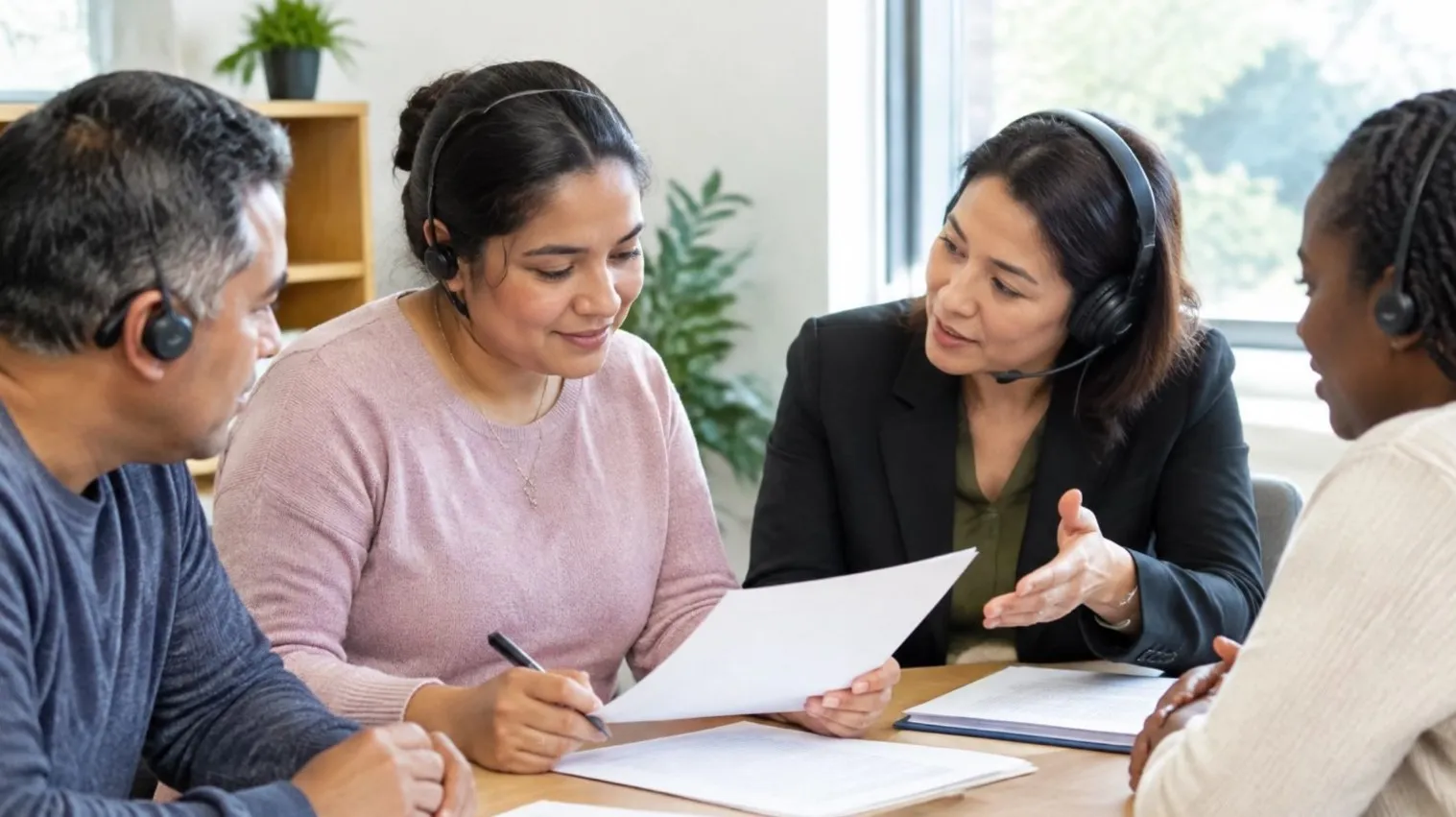
Sitting in an IEP meeting can feel overwhelming even in your first language. Now imagine trying to follow a conversation about your child's evaluation results, placement options, and legal rights in a language you're still learning. For thousands of families, that's exactly what happens when schools rely on the wrong kind of language support, or none at all.
At Spectrum Translations, we focus on accurate document translation and practical training for district staff who support multilingual families, so the written record and the people working with it are prepared for this high-stakes process.
What Happens at an IEP Meeting, and Why Language Matters
An Individualized Education Program (IEP) meeting brings together teachers, school psychologists, administrators, and parents to review a child's evaluation, set goals, and agree on services and accommodations. It's dense, technical, and often emotional. Parents are asked to absorb clinical terms, legal language, and long-term decisions about their child's education, sometimes all in a single sitting.
If a parent doesn't fully understand what's being proposed, they can't meaningfully participate in the decision. That's not just a communication gap; it directly affects whether the IEP actually reflects what the family wants and understands for their child.
The Risk of Using a Bilingual Staff Member or Family Member to Interpret
It's common for schools to lean on a bilingual staff member, or even a family member, to interpret during an IEP meeting. It seems efficient, but it introduces real risk for everyone in the room.
Why "Speaking Two Languages" Isn't the Same as Interpreting Special Education Terminology
Being conversational in two languages is different from being trained to interpret special education terminology accurately, in real time, under pressure. Interpreting and translating are two distinct skill sets (learn more about the difference), and knowing one doesn't guarantee the other. Terms tied to evaluations, eligibility categories, and behavioral plans don't always have a direct equivalent, an interpreter needs to know how to convey the meaning, not just the words. Untrained interpreters can unintentionally soften bad news, skip details they don't understand, or insert their own opinions instead of interpreting neutrally. A family member, in particular, is rarely in a position to stay neutral about their own child's evaluation.
What a Professional Special Education Interpreter Actually Does
A professional interpreter isn't just present in the room, they're actively managing a complex, multi-voice conversation so nothing gets lost.
Interpreting the Meeting in Real Time
In a well-run IEP meeting, a qualified interpreter follows the discussion in real time, so parents hear the same pace and the same nuance as everyone else, instead of receiving a delayed or simplified version after the fact.
Understanding Evaluations, Placement, and Accommodations in Your Language
Beyond the live conversation, a qualified interpreter helps parents understand what's being proposed for evaluations, placement, and accommodations clearly enough to ask questions and advocate for their child, not just nod along.
A Certified Interpreter Who Has Been in the Room, Not Just Trained for It
Spectrum Translations was founded by Sandra Ledesma, a California Certified Court Interpreter who has worked in special education interpretation and translation since 2008. She has personally interpreted at hundreds of IEP meetings, and has translated IEPs, evaluation reports, prior written notices, and meeting summaries.
That combination, courtroom-level certification and years inside the IEP process itself, is why families and districts trust the team at Spectrum Translations (learn more about our team) with documents and training where every detail matters.
What to Ask For When You Request an Interpreter for Your Child's IEP
When you're scheduling an IEP meeting, it's worth asking your school specifically:
- Is the interpreter certified, and do they have special education experience?
- Will the interpreter provide simultaneous interpretation, or will there be delays?
- Can translated copies of key documents be shared before the meeting?
Prepare District Staff for IEP Language Access
Every family deserves to fully understand, and be fully understood, during their child's IEP meeting. Spectrum Translations' Special Education Interpreter and Translator Training is for district staff and covers consecutive interpreting, note taking, managing speaker pace, professional boundaries, and common IEP terminology. Training formats include self-paced online coursework, live cohorts, and on-site workshops.
Frequently Asked Questions About IEP Interpreters
Is my school required to provide an interpreter for my child's IEP meeting?
Yes. Schools that receive federal funding are required to provide meaningful language access for parents with limited English proficiency, which includes qualified interpretation at IEP meetings.
Can a bilingual teacher or staff member interpret instead of hiring a professional?
They can, but it's not recommended for high-stakes meetings like IEPs. Speaking a language conversationally doesn't mean someone is trained to interpret clinical and legal special education terminology accurately, or to stay neutral when discussing a case they may already be involved in.
What's the difference between interpretation and translation in this context?
Interpretation is spoken, happening live during the meeting itself. Translation is written, for example, converting the IEP document, evaluation report, or prior written notice into the parent's language. Most families need both at different points in the process.
How far in advance should I request an interpreter for an IEP meeting?
As early as possible. Requesting an interpreter as soon as the meeting is scheduled gives the school time to confirm a qualified interpreter rather than scrambling last minute or falling back on untrained staff.
Am I entitled to a written translation of my child's IEP, not just an interpreter during the meeting?
Parents can request translated copies of key documents, including the IEP itself. Whether it's provided as a full written translation or summarized verbally can vary by district, so it's worth asking specifically for a written translation if that's what you need.